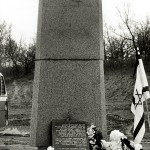
This monument was put in Rovno on November 4, 1990. It is a memorial at the place where our parents died in the Holocaust in 1941, when the war began. And only after 50 years the authorities in Western Ukraine allowed such a memorial to be built. All the former residents who survived in the tragedy gathered there, including me. Very many people came from all over the Soviet Union. My parents’ names are also cut in this monument.
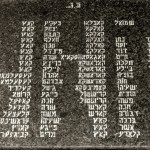
Near Rovno there is such a forest called Sosyonki. And in that forest they were all shot. Sixth from the left you can see the name of Nakhman Kats. And then you see Peysa Kats, not very clearly. And there should be my sister there too.
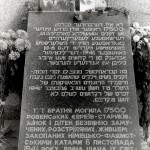
This is a memorial in Yiddish, Hebrew and Ukrainian says that 17500 Rovno Jews, old men, women and children, were guiltlessly tortured, executed and buried alive by Germans here on November 6, 1941.
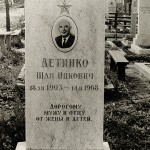
This is a monument to my husband constructed after his death. He was buried in the ‘January the 9th Cemetery’ in the so-called ‘communist site’. I had it engraved in the bottom ‘To a dear husband and father from his wife and children’. I meant his daughter, called Bella.
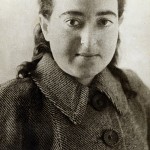
This snapshot was made in the camp in the town of Tavda. It is East Ural Lag. In the photo I am wearing the coat in which I was arrested. That was a coat made in the Rovno factory; reglan coats were fashionable then. It was flared at the bottom and I wore it for a long time. Later I re-made that coat and presented it to another prisoner from Vilnius. It was a beautiful coat. I had sparse but long hair, so I braided them.
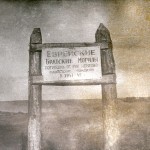
I received this photo by mail in 1945 in the camp. It is a temporary memorial to the Jews who were murdered in the Sosyonki forest near Rovno. You can see two poles and an inscription in Hebrew indicating that victims of Holocaust from Rovno were buried here, including my parents and my sister, Bella, who were executed by the Nazis on this spot in Sosyonki, a forest outside Rovno.
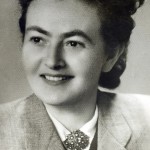
This is my older sister, Hava. She was very beautiful and all of the available men in Rovno were in love with her. In 1932, my older sister, Hava, joined a kibbutz in Poland and lived there for one year. There she met Yakov Blikh, who became her boyfriend, and who helped her to emigrate from Poland to Israel where she intended to study medicine by providing the certificates for her departure and some money. Yakov and Hava were eventually married.
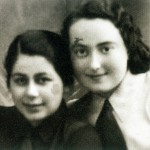
This is me with Gisya Pishaleva in 1937 in Rovno in a photo studio. I received this picture quite recently from Israel. Gisya found it in the archives of her deceased sister. It was a shock for me to receive this photo after so many years.
In this picture we are seeing off our relatives to Israel in 1937. On the right is my brother Aron, and on the left is Daddy, Mum and my sister Bella. And in the middle are all those relatives who left for Israel. I am not in this photo, because I had been in a kibbutz then — in the town of Slonim in Baranovichi district.
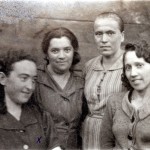
This is a picture from the labor camp’s sewing workshop, where we worked. I do not know who took this snapshot but I kept it, and it’s dated 1945. I am the first from the left. Second from the left is the Jewish girl Haya and third is a Russian woman. Fourth is Dina. She was arrested in Harbin, a Chinese town.
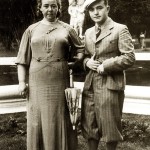
On this amateur snapshot is my Mum in 1935 at the age of 38 and my brother Aron. It was redone in Israel for me, so that I could have some memory of my folks. This was in a resort in Zakopane in Poland. They are dressed in the Polish style. The handsome brother, the beautiful mum, wearing a nice dress. Brother has such short trousers on, called breeches — that was the fashion then, and a cap on his head.
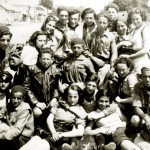
A photo from ‘Hashamer Hazair,’ ‘The Young Watchmen’. My friends and I went to the Lvov region, to a pioneer camp. We rented an attic and lived there, sleeping on hay— boys on one side, girls on the other. We were wearing this kind of uniform: a grey shirt and a dark blue tie. The regular pioneers wore red ties. We had shirts with pockets, whistles, all the stuff. We were all dressed this way.
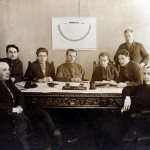
First from the left at the table in an armchair with crossed legs is my husband Shaya, when he was the rector of Higher Communist University. He is depicted with his comrades at work. That photo was made in 1935. Second from the right at the table holding a sheet of a paper is Yuri Repin, a friend of my husband.
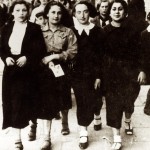
In this photo you see us walking in Rovno after a meeting in ‘Hahamer Hazair’ in 1936. I am the second from the right. First from the right is Gisya Pishaleva, my friend. We lived in the same house. Her parents rented a two-room apartment in our house. Third on the right is Hana Bokser. Hana is dressed in the uniform, which we all used to wear— a grey shirt with pockets, a dark blue skirt. I do not remember the girl at the left.
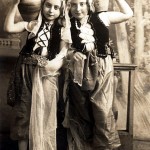
Here we are dressed up for Purim in oriental costumes, with jugs, and we danced as well as we could. These costumes I sewed myself. My sister Hava helped me. When I was a girl, I presented this photo to my friend Sara Shenfeld, who now lives in Israel. She returned it to me when I was in Israel in 1989, and I am very happy about that, because I had no photos after the camp and the Holocaust. On the reverse side there is an inscription in Hebrew that I presented that photo to Sara: ‘For eternal memory to my good friend Sara from Hava and Haya. 1932.’
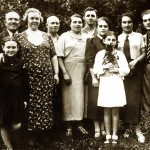
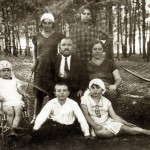
We are in our summer residence in Novostav in 1927. I am sitting in the first row on the right, my brother Aron to the left of me and on a chair — my sister Bella. I am 7 years old, my brother is 8, and Bellochka is 2 years old. In the second row in the hammock is my mum and beside her my daddy. In the third row standing on the right are my Aunt Malka, mother’s sister, and my elder sister Hava.
Хая-Лея Нахмановна – культурная, очень гостеприимная женщина восьмидесяти двух лет. Она прекрасно помнит подробности своей трудной жизни, а также жизнь своих предков. Она гордится своими родственниками. Несмотря на пятнадцатилетние испытания будучи политзаключенной в лагере, лучшие части ее души остаются нетронутыми. Она хочет, чтобы мужество ее родственников послужило примером для будущих поколений. Хая Нахмановна считает, что ее долг – рассказать эти истории еврейской жизни и воздать должное силе своей семьи.
Читайте полное интервью c Хая-Лея Детинко здесь (на английском) и здесь (на украинском).